
Request an Appointment or Give us a call
What is Femoral Cam Deformity?
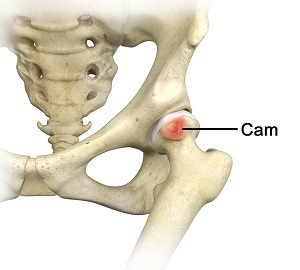
Femoral cam deformity, also referred to as cam impingement, is an irregularity or malformation of the ball at the top of the femur, or thigh bone.
The hip is a ball-and-socket joint where the head of the femur forms the ball, and the pelvic acetabulum forms the socket. Femoral cam deformity involves the femoral side of the hip joint and occurs when the femoral head and neck are not perfectly round, usually due to bony overgrowths (bone spurs). This lack of roundness causes a poor fit of the femoral head in the socket, leading to abnormal contact between the surfaces. As a result, the soft-tissue structures such as the labrum surrounding the joint become pinched, leading to significant pain, reduced range of motion, and loss of hip function.
What are the Causes of Femoral Cam Deformity?
A cam deformity is a developmental problem that appears more often in adolescents engaged in sports. In these adolescents, being involved in certain sports while the growth plate is open can prompt the growth plate of the hip to form excess bone, causing the deformity.
Other risk factors that can contribute to the development of a femoral cam deformity include the following:
- Coxa vara - an unusual hip condition in which there is a discrepancy of growth in the femoral head and the upper end of the thigh bone
- Slipped capital femoral epiphysis (SCFE), a slipping of the femoral head
- Legg-Calve-Perthes disease, a hip disorder seen in children aged 4 to 10
- Anatomical abnormalities of the femoral head or angle of the hip
- Trauma to the hip
- Inflammatory arthritis
- Congenital hip dislocation
- Sports such as football, hockey, weightlifting, or similar activities
What are the Signs and Symptoms of Femoral Cam Deformity?
Some of the signs and symptoms of femoral cam deformity include:
- Pain, which may be a dull ache or a sharp pain
- Groin pain associated with hip activity
- Complaints of pain in the front, side, or back of the hip
- A locking, clicking, or catching sensation in the hip
- Pain in the inner hip or groin area after prolonged sitting or walking
- Difficulty walking uphill
- Restricted hip movement
- Lower back pain
- Pain in the buttocks or outer thigh area
How is Femoral Cam Deformity Diagnosed?
Femoral cam deformity is diagnosed based on a review of your medical history, a thorough examination of hip motion and gait/walking pattern, and diagnostic studies, such as X-rays, MRI scans, and CT scans to check for any anatomical abnormalities.
What is the Treatment for Femoral Cam Deformity?
Approximately 60 percent of femoral cam deformity cases can be treated non-surgically. Surgical intervention is only reserved for severe cases of cam deformity and when a non-surgical approach has been unsuccessful.
Nonsurgical Treatment
The mainstay of nonsurgical treatment for femoral cam deformity is physical therapy. Other non-operative options may include:
- Activity modification
- Non-steroidal anti-inflammatory drugs (NSAIDs)
- Corticosteroid injections
Surgical Treatment
Cam surgery, also known as femoroplasty, is the surgical procedure performed for the treatment of cam deformity. The surgery is usually performed as a minimally invasive arthroscopic procedure and involves reshaping of the femoral head and neck and removal of any extra bone or cam lesions using special instruments. Any damage to soft-tissue structures such as the cartilage and labrum are also addressed during the operation.
Surgery is immediately followed by rehabilitation and involves a focused physical therapy program.
For more information about Hip and Knee, or to schedule an appointment, call us at or click here to request an appointment online. We’ll respond to you as soon as possible.